|
The PHOENIX is now considered the state-of-the-art design of composting toilets.
Read about the advantages of a Phoenix below:
The advantages of the Phoenix are many.
- It is easy to install:
smaller tank sections, no caulking, simple vent and toilet.
- It is
easy to maintain:the access door to the compost is on the face of the tank,
and removal of the compost is controlled by
rotatable tines which control compost movement to the access area and keep
material at the bottom of the tank uncompacted and aerated.
- A permanent
medium provides secondary liquid treatment
beneath the sloped bottom baffle.
- Air travels over the
entire surface of the liquid to increase evaporation and aerobic conditions.
- The liquid is separated by the screened liquid baffle for easy removal;
accumulating liquid can be removed with the
hand pump and used to moisten the compost pile, and excess liquid canbe
drained to a leach field or holding tank.
- Ventilation is provided
by a low power DC fan operated by a small
power supply or photovoltaic system. Flexible 4" duct and rigid 4" PVC pipe are easily installed. Continuous
air baffles along the tank sides provide aeration
of the compost pile and do not interfere with compost movement. Their
large surface area allows the insulated tank
to be readily warmed with circulating air from a heater
or solar collector.
- One or two toilets connect to the Phoenix with
12" diameter pipe. Toilets are made
from vandal-resistant polyethylene and ABS.
- ADA: The Phoenix dry toilet fixture is compliant with the Americans with Disabilities Act. In addition, the Neptune Foam Flush and the new Jets vacuum toilet fixtures can be ordered with the correct height.
- The Phoenix system
is complete with all components necessary for installation, including a
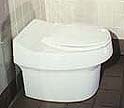
white contemporary toilet, a food waste inlet
with a maple chopping block option, and the vent system;
only the peat/wood-chip starter bed for the tank is not supplied.
Additionally, the package contains all maintenance
tools needed: a door counter to tally use for public facilities,
a compost rake, liquid recycling/removal pump, and compost tray.
Nesting parts allow shipping at class 100 rates from
Whitefish, MT.
- Read on for even more advantages.
For an overview on the Phoenix, read this article comparing the Phoenix composting toilet to the original Clivus Multrum.
 |
Using the Phoenix in
Homes & Cabins |
|
|
|
ACS manufactures three models of the Phoenix
Composting Toilet for use in private residences. Several toilet-to-tank
configurations are possible for each model, providing plenty of options
for refits or new construction.
|
|
|
|
Advantages
of the Phoenix
Odorless. Aerobic
decomposition and a ventilation fan ensure that there are no unpleasant
odors in the toilet room, tank area, or around the building. Finished material
is inoffensive.
Waterless. No
flushing saves annually up to 10,000 gallons (38,000 liters) of water per
person.
Rugged. Thick,
tough, insulated polyethlene walls, and corrosion resistant fittings. Lasts
a lifetime.
Capacious. Accommodates
families, guests, hordes of relatives, occasional occupying armies.
Owner-friendly.
Field proven design ensures easy maintenance. Finished compost is removed
just once a year.
Frost-safe.
Freezing does not injure the composting process. Use of the Phoenix in
cold weather can continue at a lower rate. Composting resumes when the
system warms up.
Energy efficient.
A 5-watt fan is the only electrical load in residential units.
Chemical-free.
Composting uses a wide variety of organisms to biochemically decompose
wastes. The only additive is a bulking agent such as wood shavings.
Clog-proof.
Items such as apples that stop up conventional flush toilets won’t clog
the wide chutes connecting the toilet and food waste inlet to the Phoenix
composting tank.
Non-polluting.
Wastes are totally contained in the Phoenix. No cracks, no leaks. A long,
uniform, retention time ensures a stable, biologically benign end product,
reduced 80&endash;90 percent in volume, that can be easily transported
or disposed of on-site.
Back
to top |
|
Phoenix
Residential Models
Phoenix residential
packages contain all of the components necessary for an installation except
for the wood shavings starter bed for the tank, and the 4-inch (100mm)
rigid vent pipe. Every package includes a Phoenix tank, one toilet with
three feet (910mm) of chute, a complete ventilation system, a manual liquid
respray system, a compost bin, rake, and installation and operating instructions.
Capacity. ACS
manufactures three residential Phoenixes. Capacities range from two to
eight persons. The capacity of the Phoenix system greatly depends upon
the temperature of the compost pile. The rate of composting is significantly
influenced by temperature: the warmer the tank, the faster the composting.
Warm tanks have a higher capacity than cold tanks. Our capacity ratings
assume a minimum tank room temperature of 65F (18C), our minimum recommended
temperature. Below 55F (13C), composting is very slow.
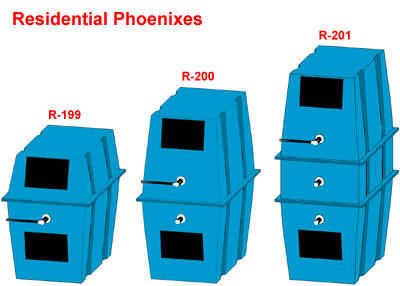
The R-199
“cabin model” can be used continously by two persons.
The R-200 accommodates
four full-time users.
The R-201 accommodates
eight full-time users.
Models R-199 and R-200
can be upgraded by adding a midsection.
|
R-199
|
R-200
|
R-201
|
| Height |
56"
|
73"
|
92"
|
| Width |
39"
|
39"
|
39"
|
| Front-back |
61"
|
61"
|
61"
|
| Capacity |
2-person
|
4-person
|
8-person
|
Peak use. The Phoenix’s
large volume allows it to accommodate peak use well in excess of its nominal
rating &emdash; an important advantage in seasonal situations such
as family reunions. The annual average use should not exceed the rating,
but very heavy use over relatively short periods is handled easily.
Back
to top |
|
Residential
Installation Options and Planning Guide
The area in which the
tank is located should be at least 40 (1,000mm) inches wide. Five feet
(1,500mm) of clear space in front of the Phoenix must be provided for maintenance.
This area should also be at least one foot (30mm) taller than the tank.
The surface supporting the Model 201 Phoenix should be flat, level and
capable of supporting 4,000 pounds (1800 kg).
 |
-
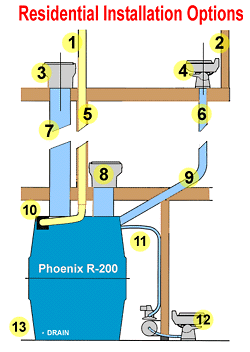
1 - Centerline of chute
must be at least 9 inches from wall.
-
2 - Centerline of pipe
must be 12 inches from wall.
-
3 - Standard toilet installed
on second floor.
-
4 - Gravity micro-flush
toilet installed on second floor.
-
5 - 4-inch diameter vent
pipe.
-
6 - 4-inch diameter pipe.
-
7- 12-inch diameter chute.
-
8 - Standard toilet installed
on first floor.
-
9 - 1-in-10 minimum slope
south of angle.
-
10 - 12 inches between
tank top and ceiling
-
11 - 1.5-inch diameter
hose.
-
12 - Vacuum-flush toilet
installed on same floor as Phoenix.
-
13 - 60 inches between
wall or door and front of Phoenix.
|
All Phoenix tank models
are 39 inches (990mm) wide and 61 inches (1,550mm) long. Model 199, the
cabin unit, is 55 inches (1,400mm) tall; the Model 200, 73 inches (1,850mm);
Model 201, 92 inches (2,300mm). The unassembled Phoenix fits through an
opening 38 inches (970mm) wide, the width of a rough opening for a 36-inch
(910mm) door.
Standard toilets
connect to the Phoenix tank with 12-inch (310mm) diameter chutes that must
be vertical (see drawing at left). One Phoenix tank can accommodate two
standard toilets if they are located back-to-back. The toilets can be located
several stories above the tank. The minimum clearance from the center of
the toilet chute to the finished surface of the wall behind the toilet
is 9 inches (230mm).
Gravity micro-flush
toilets provide an alternative for installations requiring a toilet
not directly above the Phoenix. They connect via a 4-inch (100mm) pipe
and require a one-pint water flush. The maximum horizontal offset from
the Phoenix is 10 feet (3,000mm). The minimum slope is one-in-ten.
Vacuum-flush toilets
offer an alternative for installations requiring a toilet on the same floor
as the Phoenix (see drawing at left). They connect via a 1.5-inch (38mm)
diameter hose, and require running water and 12 or 24-volt electricity.
Drain. Micro
and vacuum-flush toilets increase the amount of liquid end product in the
Phoenix. Excess liquid decants through the tank’s drain.
The ventilation
system mounts directly on either side of the Phoenix. Four-inch flexible
hose screws into the fan housing, adapting to 4-inch (100mm) rigid pipe
for exiting the roof. Roof supports and flashings adjust from flat to 12/12
pitches. In cold climates, insulate the vent pipe reduce frost accumulation
and condensation. With high snow loads, the vent should exit near the roof
ridge.
Electrical loads.
The only electricity required for residential Phoenixes is for the 12-volt
d.c., five-watt ventilation fan (120 watt hours per day).
Back
to top |
|
How
Composting Toilets Function
Human and food wastes compost
in the Phoenix’s oxygen-rich environment. The principle is the same as
in a common garden compost pile: dehydration and digestion greatly reduce
the volume of the organic material, the texture becomes moist and crumbly,
and the long and uniform retention time destroys many pathogenic organisms.
Offensive odors diasappear.
A fan drawing air through
the tank and up the vent stack assures adequate oxygen for aerobic decomposition
and odorless operation. A bulking agent (wood shavings) increases liquid
drainage, aeration, and provides additional carbon. Manually rotated tines
control the movement of material to the bottom, keeping fresh waste from
contaminating the finished compost during its removal through the lower
access door.
Liquid filters through the
compost pile and is further stabilized in the well-aerated, permanent liquid
treatment medium in the bottom of the tank. Continual evaporation usually
prevents needing to drain or otherwise remove liquid from the tank.
Back
to top |
|
Graywater
Treatment Options
Several options exist for
treating graywater. Treatment systems that utilize natural biological processes
require less energy, and are simplier and more reliable.
Health department approval.
Graywater disposal systems usually require local health department approval
prior to installation.
Conventional septic system/leach
field. Because of graywater’s lower flow volume, reduced oxygen demand,
and lower suspended solids, the size of the septic tank and field can be
reduced significantly. Alternatives to the septic tank, such as a roughing
filter or forced aeration system, can enhance treatment before infiltration.
Leach water can be used to irrigate nonfood plants.
Constructed wetland.
A diverse collection of aquatic plants is grown in a layer of gravel in
a lined shallow trench. The root zone of these plants provides an aerobic
environment for bacterial treatment of the flowing graywater. Treated water
infiltrates the soil from an unlined portion of the trench. Nutrients can
be recovered through biomass removal.
Aerobic infiltration bed.
A coarse organic cover isolates the treatment area while allowing air exchange
and providing a large surface area for biological activity and freeze protection.
Increased longevity and significant nutrient recovery can be effected by
alternating between two beds. In cold climates, the treatment can occur
within a greenhouse.
Surface irrigation.
Graywater can be spray irrigated on non-food plants. Treatment occurs in
the biologically rich topsoil layer. Nutrients are recovered in the biomass.
Back
to top |
|
Copyright 1999, Advanced
Composting Systems, all rights reserved.
|
Return to list of TOILET UNITS
Return to HOME page
|